Imagine an honest and curious person.
That is looking out at the vast expanse of the ocean, struck by a simple urge. To explore it.
Now imagine this person falls in love with that experience, starts kayaking and then, decides they want to share this joy and become an instructor of sorts.
From that point onwards, that initial passion and inspiration, will be slowly strangled by an alphabet soup of staggering bureaucracy.
They will be met with acronyms like the British Canoe Association (BCU), the European Paddle Pass (EPP), or the Norwegian Paddling Association (NPF). They will be handed laminated checklists, subjected to rigid curriculums, and introduced to a profoundly Western mindset of teaching through fear.
And somewhere along the way, they will entirely lose the passion that started their voyage.
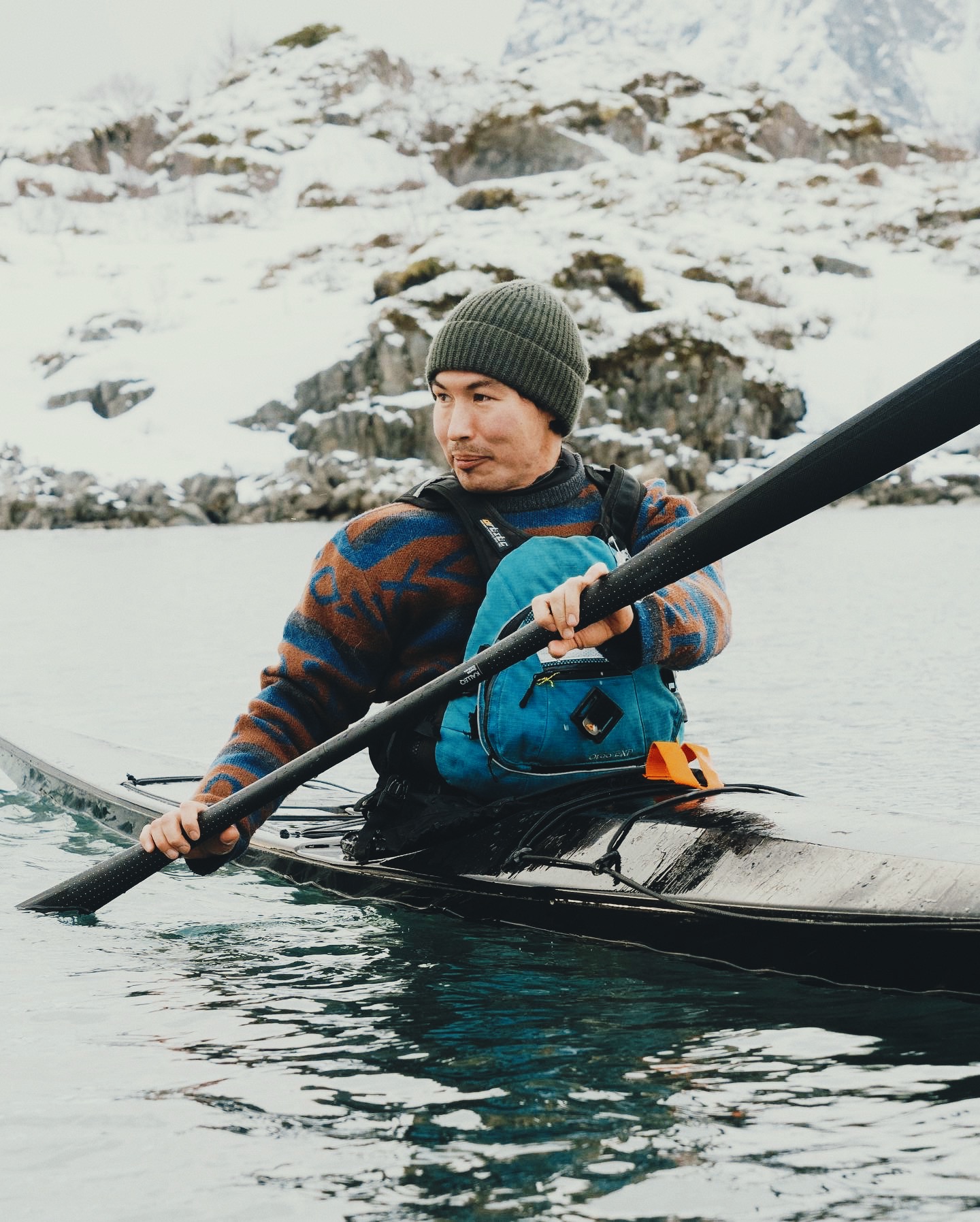
I am Kristian Louis, founder of Purpose Paddling. My mother is Greenlandic, my father is Danish, and I have had the immense privilege of guiding kayak expeditions all over the globe. I have spent my life bridging these two worlds. And I am here to tell you that the modern, institutionalized kayak instructor ladders of the world have taken a masterpiece of indigenous arctic survival, the Qajaq, and fundamentally misunderstood it.
We don’t need the “Canoe Associations of the World” to teach us how to kayak. We need the indigenous wisdom that invented it.
Midlife crisis in a neoprene suit
To understand how far we have drifted, we must first look at the gatekeepers of modern paddling. I have seen this machinery firsthand. I have obediently navigated the NPF paddle ladder and jumped through the hoops of the EPP.
Both experiences left me thoroughly, remarkably disappointed.
What you find at the top of these ladders is rarely a quiet mastery of the ocean. Instead, you find a highly specific demographic. Overly geared instructors, clad in high-visibility neon, bristling with towing lines, GPS units, and carabiners. They look less like people going for a paddle and more like they are preparing to defuse a remarkably damp bomb.
Too often, this hyper-structured pedagogy seems driven by an unspoken, perhaps unconscious, inferiority complex or a midlife need for absolute control.
The ocean is chaotic, unpredictable, and vastly indifferent to human existence.
To a certain type of mind, this is terrifying.
Therefore, the institution attempts to conquer the ocean with paperwork.
They create “levels” and “stars,” breaking the infinite complexity of the sea into digestible, controllable, highly marketable weekend courses.
I remember a specific moment during my NPF training that perfectly encapsulated this absurdity. I brought my Greenlandic paddle, a slender, un-feathered, symmetrical blade.
The instructor, a man fiercely dedicated to the modern curriculum, looked at it with mild disdain and told me I wasn’t allowed to use it.
“The Greenland paddle is not good enough in waves,” he said, without a hint of irony.
I stood there, processing this. Here was a man telling me that a design painstakingly perfected over 4,000 years by the Inuit in the freezing, unforgiving, gale-battered waters of the Arctic was somehow structurally deficient.
And he, armed with a modern, asymmetrical plastic spoon, had the audacity to declare the European invention “safer.”
It takes a breathtaking amount of colonial hubris to look at four millennia of indigenous survival beta-testing and say, “No thanks, this one is CET certified, the world has moved on.”
The pedagogy of paranoia
The standard instructor, often a Caucasian male heavily emphasizing SAFETY, SAFETY, SAFETY, uses fear as a primary teaching tool. The entire paddling world has been penetrated by the philosophies of such men.
“We are teaching people how to survive a disaster before we have even taught them how to enjoy the water.”
The course content is heavily skewed toward worst-case scenarios. We drill rolls, wet exits, and complicated rescues until the student is blue in the face. We emphasize what will go wrong, how dangerous the water is, and how quickly one might perish without the proper sequence of strokes.
I would argue that this approach actively scares people away. It strips the joy, the active curiosity, and the simple thrill from the sport. It turns potential lifelong paddlers into anxious over-thinkers who believe that unless they have mastered a bomb-proof combat roll and memorized a manual, they have no business being on the water.
The silence of the Elders
Why, then, haven’t the Inuit simply stepped up and claimed an official “Instructor Ladder” and a trademarked method?
The answer lies in the very philosophy that the Western institutions lack: Humility.
The Inuit from all over the Arctic, are fundamentally nature peoples.
They are too cautious, too deeply respectful of the environment’s shifting moods, to arrogantly write down a definitive list of “what is right.”
“They know that the ocean does not read syllabuses. They will often be quiet and wait for the person to realise themselves, the answer to their questions. What the indigenous elders understand is that mastering the Qajaq requires curiosity and a calm humble mindset.”
It requires vast amounts of time spent simply being at sea, feeling the current, reading the wind, and figuring out what works for the individual body in the boat. Humility and a fluid approach to the environment are exactly what we need to cultivate safer, more masterful kayakers.
You do not conquer the ocean by completing a ladder of skills.
Mindset is the first and most critical thing we must cultivate.
We should be allowing beginners to make mistakes in a supportive environment, to laugh when they capsize, and to fundamentally reconnect with nature, rather than treating the sea as a hostile entity that must be outsmarted.
The paradox of paper competence
If we look at the statistics regarding kayaking accidents worldwide, a troubling pattern emerges that suggests our current teaching model is fundamentally broken.
Too many accidents happen for two distinct reasons:
- The paralysis of Fear: Beginners who have been taught through the pedagogy of paranoia freeze up when things go wrong, expecting disaster because that is all they were trained for.
- The illusion of Mastery: Intermediate paddlers get into trouble because they feel too great a sense of mastering. Armed with a Level 3 certificate, they paddle into conditions well beyond their actual oceanic intuition. They mistake paper competence for environmental wisdom.
We ought to teach kayaking the way the elders do. Not by passing a test, but by encouraging an organic understanding of our own limits. The Inuit approach focuses on ocean knowledge, community, and purpose. You paddle with others, you learn through observation, and you stay ashore when the sea tells you to, regardless of what your laminated card says you are “cleared” to paddle in.
Reclaiming the purpose
I am not here to prescribe a rigid, 12-step program for a “Greenland Qajaq Instructor Course.” Doing so would simply repeat the mistakes of the institutions I am criticizing.
But I am here to point out that the way the British, the Americans, and the Europeans are currently doing it is missing the soul of the craft. It is overly bureaucratic, unnecessarily fearful, and disconnected from the origins of the boat itself. It is scaring away thousands of people who could otherwise reap the immense physical and spiritual benefits of this amazing pursuit.
It is time to return to the source. It is time to regain the purpose of the paddle.
To the Inuits out there and all people who truly know the way of the Qajaq: let us unite.
Let us find a way to restore the teaching of this beautiful craft by listening to the quiet, ancient wisdom of our elders, rather than the loud, neon-clad certainty of a bureaucratic midlife crisis.
The water is waiting. Let’s go for a paddle and listen to what the ocean tells us.
From what I hear it saying, it needs more people actively restoring and helping it, than instructors who teach how to conquer it.